

.png)

Lithium-ion battery fires in skips and waste facilities are now one of the most serious and fastest-growing hazards in the UK waste management industry and they are entirely preventable.
From disposable vapes to e-scooters, more battery-powered products are entering the waste stream incorrectly disposed. The consequences for people, infrastructure, and the environment can be catastrophic.
The Scale of the Problem
Lithium-ion batteries are now one of the leading causes of fires in the UK waste and recycling sector. According to the Environmental Services Association, the risk is escalating rapidly across the industry.
Figures from the National Fire Chiefs Council (NFCC) illustrate just how serious this has become:
This is not an isolated problem; it is happening daily across the UK. At Dunmow Group, we see the impact first-hand.
The Fire Science: Why Lithium-Ion Batteries Are So Dangerous
Understanding why these batteries are so hazardous in a waste environment requires a brief look at the underlying chemistry, because the risk is not obvious, and that is precisely what makes it so dangerous.
Thermal Runaway: A Three-Stage Cascade
When a lithium-ion cell is mechanically damaged, crushed, punctured, or deformed a predictable and often unstoppable sequence begins:
This cascade is self-sustaining once Stage 2 begins. In a multi-cell pack of e-bikes, power tools, and laptops, thermal runaway in a single cell propagates to adjacent cells. This is called cell-to-cell propagation, and it is the primary reason why a single e-bike battery in a skip can destroy the entire vehicle.
Why Conventional Suppression Fails
Lithium-ion battery fires do not respond to conventional suppression in the way that ordinary material fires do. Three critical factors apply in waste environments:
Fire Engineer Note: The NFCC guidance "Fires Involving Lithium Batteries" (2023) advises that the primary tactical objective for a vehicle fire involving lithium-ion batteries is life safety and exposure protection not extinguishment. Full suppression may require immersion in a purpose-built water tank. This is a material difference from standard vehicle fire response.
Not All Lithium Batteries Are Equal: Chemistry Variants and Risk Profiles
Battery chemistry varies significantly across consumer products, with differing thermal stability profiles:
The practical implication: the disposable vape is now the highest-volume lithium battery entering skip waste, containing LiPo chemistry, the most reactive under crush loading. A skip containing building debris and a handful of discarded vapes is a credible ignition scenario.
The Regulatory and Legal Framework
The legal position for waste producers, skip hirers, and waste operators is clear and increasingly stringent:
For commercial customers, construction firms, electrical contractors, and facilities managers, the duty of care is direct. Knowingly placing batteries in a skip constitutes an illegal waste transfer and may expose the waste producer to enforcement action by the Environment Agency.
Where Battery Fires Occur in Waste Operations
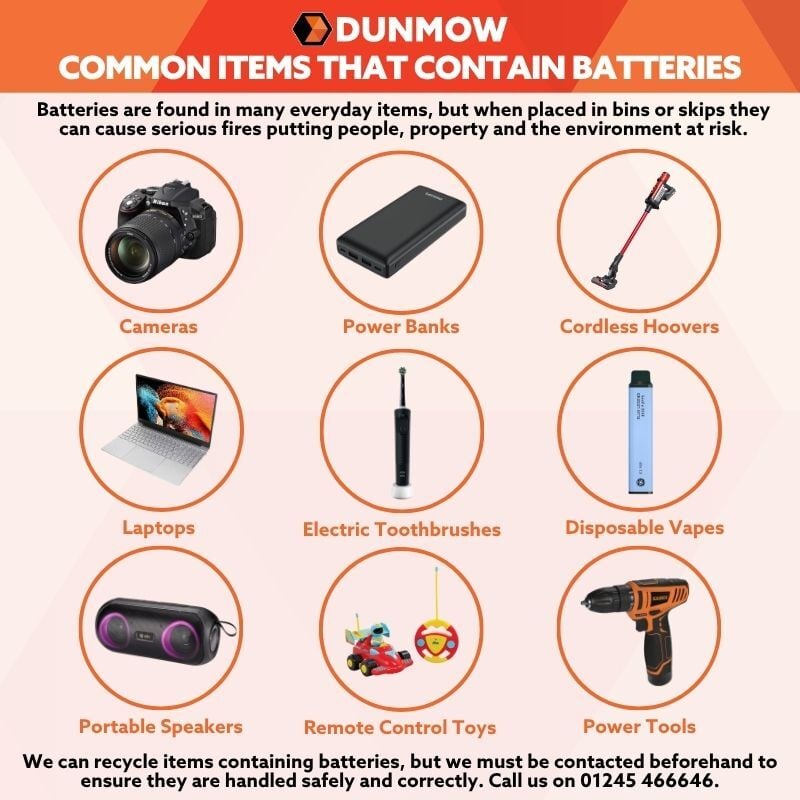
Common Items That Must Never Go in a Skip or General Waste
Many items people consider ordinary household or site waste contain lithium-ion batteries. Once in the waste stream, they become a serious hidden fire hazard. The most common culprits include:
If it has a charging port or uses a rechargeable battery, it must not go in a skip or general waste bin.
How to Dispose of Batteries Safely and Legally
Safe battery disposal is straightforward and free. Batteries must never be placed in general waste, kerbside recycling, or skips. Dedicated battery and WEEE recycling points are widely available:
Find your nearest certified collection point at: recycleyourelectricals.org.uk.
Why This Matters to Dunmow Group and to You
As battery-powered products proliferate, the risk to the waste sector will only intensify. At Dunmow Group, we witness the consequences directly. A single incorrectly disposed battery can destroy a collection vehicle, force a full site shutdown, damage critical infrastructure, delay service for hundreds of customers, and, most importantly, put our people's lives at risk.
This is not a waste management issue in isolation: it is a public safety issue, and every customer, domestic or commercial, has a role to play.
Dunmow Group Policy: Batteries Are Strictly Prohibited in Our Skips and Yards
To protect our people, our customers, and our operations, Dunmow Group does not accept batteries of any kind in our skips or at any of our sites. Batteries are restricted items. If batteries are found in incoming waste loads, this may result in a refused collection or additional charges.
We ask every customer to check their waste carefully and remove any batteries before disposal. This is one of the fastest-growing risks in our industry, but it is also one of the simplest to prevent.
Need Help With Battery or WEEE Disposal?
If you need guidance on safely and legally disposing of batteries, battery-containing items, or WEEE, the Dunmow Group team is here to help. Call us on 01245 466646 or email sales@dunmowgroup.com to arrange a separate, fully compliant collection. We are here to make responsible waste disposal easy for you and for everyone.
|
Commercial & Trade Customers: Your Legal Obligations If you operate a business a construction site, electrical contracting firm, facilities management operation, or any commercial premises your duties around battery disposal go beyond general awareness. They are statutory. Duty of Care (Environmental Protection Act 1990): Any business that produces, carries, or disposes of waste has a legal duty to ensure it is handled correctly. Placing batteries in a skip knowingly or without checking constitutes a breach of that duty and an illegal waste transfer. DSEAR 2002 (Dangerous Substances and Explosive Atmospheres Regulations): Where battery-containing waste is stored, transferred, or processed on commercial premises, operators must assess and control the risk of fire and explosion from flammable gases that batteries can release. This includes site storage of skip-bound waste. Waste Transfer Documentation: All business waste, including battery-contaminated loads, requires a valid Waste Transfer Note. Refusing a load due to battery contamination is the operator's legal right; the liability for correct segregation rests with the waste producer. Practical steps for commercial customers: For commercial battery and WEEE collections, contact Dunmow Group directly: 01245 466646 | sales@dunmowgroup.com. |
Editorial Review & Accuracy Statement: The technical content of this article has been reviewed for accuracy against the following published sources and regulatory frameworks: NFCC "Fires Involving Lithium Batteries" guidance (2023); Environmental Services Association annual fire statistics; Environment Agency duty-of-care guidance; DSEAR 2002 and its Approved Code of Practice (L138); Hazardous Waste Regulations 2005; Waste (England and Wales) Regulations 2011; and standard electrochemical literature on lithium-ion cell failure mechanisms. Battery chemistry data is consistent with published IEC 62133 and UN 38.3 testing framework classifications. This article was originally published in April 2026 and will be reviewed for accuracy on a rolling 12-month basis or following any material change in UK regulatory guidance. Readers with specialist corrections or additions are welcome to contact sales@dunmowgroup.com.



No Comments Yet
Let us know what you think