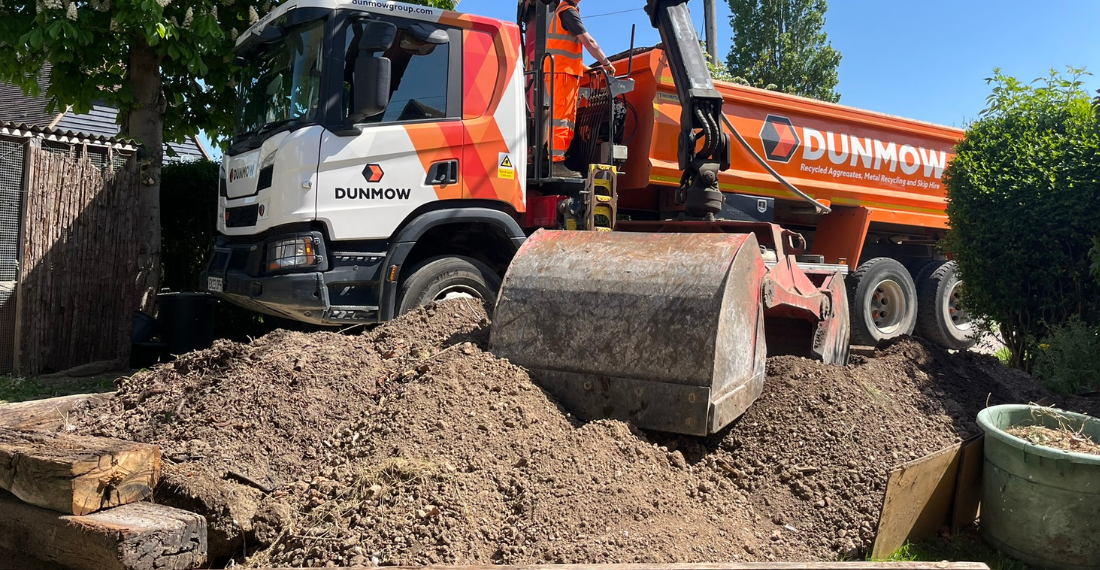

To most people, muck is muck: a pile of brown stuff to be carted off-site and forgotten. After a career in earth and materials science, I can tell you it is nothing of the sort. What comes off a site is a layered material with very different properties, destinations, and value. Knowing the difference between paying to bury a valuable resource and recovering it. This piece explains the main types of muck, where each goes, and why it matters to your job and your bill.
Muck-away is the excavated material removed from a site: the soil, subsoil, clay, and stone that come out of a dig. It is not rubbish, and keeping general waste out of it is a subject in its own right, which we cover separately. Muck arrives in layers because the ground is layered, and the order in which those layers come out, topsoil first, then subsoil, then clay, already tells you a great deal about what you are looking at and what it is worth.
Topsoil is the top layer, typically the first 200 mm to 300 mm of soil. It is dark, rich in organic matter, and teeming with biological life. It is the most valuable material in the whole profile and the most recoverable. Screen out the roots and stones, and clean topsoil becomes a resellable product for landscaping and growing, marking the start of the recycling journey we describe in a dedicated piece.
Its key property is its high organic content. That is exactly what makes it superb for growing and poor for structural use, because organic matter decomposes over time. Topsoil used as deep fill will settle as it breaks down, which matters a great deal when the ground is being rebuilt. The practical point for your job is simple: clean topsoil is the one type of muck most likely to be worth money rather than to cost money to move.
Below the topsoil lies the subsoil. It contains far less organic matter and far more minerals, a mix of sand, silt, clay, and stone that varies with the local geology. Much of it is what the trade calls screenable, meaning soil mixed with stone that can be washed and screened to recover usable sand, stone, and aggregate. The recovered fraction, typically stone and brick from around 40 mm to 80 mm, becomes a saleable recycled product rather than being sent to landfill.
Its key property is its lower organic content, which makes it more stable than topsoil but less cohesive than pure clay. The practical point is that a great deal of subsoil is recoverable, and recovering it keeps your disposal costs down because washed and screened material avoids the higher cost of landfill.
Clay is the cohesive, fine-grained material that forms the deepest layer across much of Essex. It has very little organic content, very low permeability, and it holds together. On its own, it is not much use for growing, and it does not screen into a saleable aggregate, so it usually goes to a restoration or recovery site as clean fill.
That low value as a product is precisely what gives it value as engineered fill. Clay is stable, does not break down, and is used to build up and seal the ground, a role we examine in detail in a separate piece on clay as engineered fill. Its key property is that it is cohesive, stable, and impermeable. The practical point is that clay is usually the type of muck that costs to move rather than earns, but it has a genuine engineering job to do at the other end.
You do not need a laboratory to make a sensible first call on site. Topsoil is the dark, crumbly top layer, full of fine roots and organic matter, and it comes off first. Subsoil lies beneath it, usually lighter in colour and grittier, often with stone running through it. Clay is the deepest of the three, smooth and dense, frequently grey, blue-grey, or orange, and noticeably sticky when wet.
A quick squeeze in the hand tells you most of what you need to know. Clay moulds and holds its shape. Sandy subsoil crumbles and falls apart. Topsoil is dark and threaded with fine roots. None of this replaces a formal soil classification where one is required, as explained in our soil report guide, but it does help you describe your material accurately when you book, and an accurate description is what gets the load routed correctly the first time.
When land is restored, the layers are placed in a deliberate order for sound engineering reasons. Clay goes in first to build sturdy, stable ground, because it holds its shape and does not decompose. Topsoil goes on last, for the green finish that lets the site become a field, a park, or a golf course.
Put it the wrong way round and you store up trouble. Topsoil buried deep decomposes, settles, and can leave voids and cause subsidence years later. That is why poorly restored ground keeps moving for decades, and why so many former tips become golf courses rather than housing estates. The science of building stable ground from recovered material is a subject we return to in the clay piece, but the headline is this: the value of each type of muck depends on putting the right material in the right place.
Every site is different, but most muck falls into one of these categories.
|
Type |
What it is |
Typical destination |
Recoverable value |
|
Topsoil |
Dark, organic-rich top layer, great for growing |
Screened and resold as a topsoil product |
High, often a resourcer rather than a cost |
|
Subsoil (screenable) |
Mineral soil mixed with stone, lower organic content |
Wash plant or screener to recover sand, stone, and aggregate |
Medium, much of it is recoverable |
|
Clay and heavy subsoil |
Cohesive, fine-grained, stable, impermeable |
Restoration or recovery site as engineered fill |
Low as a product, high as engineered fill |
|
Stone and hardcore |
Brick, concrete, and natural stone |
Crushed and recycled as aggregate |
Medium to high |
|
Contaminated or mixed muck |
Soil mixed with general waste, no longer inert |
Higher-cost disposal route |
Negative, it costs you |
Each load is different, which is why our drivers assess the muck on site, so it can be routed for the best result and the best price rather than treated as one undifferentiated pile.
Three practical points follow from all of this.
Our five values, Passion, Innovation, Trust, Community, and Hard Work, are how we run the grab operation, not just a poster on the wall.
Choosing Dunmow Group means choosing a partner that is safe and compliant, delivers value for money, and keeps muck away fast and easy. We do what we say, and we treat your material as the resource it often is.
Muck is not just muck. It is topsoil, subsoil, clay, and stone, each with its own properties, destination, and value. Know what you are moving, and you can turn a disposal cost into a recovery opportunity. Tell us what you are digging, keep your grades separate where you can, and we will route the material for the best outcome. Talk to us.
Chelmsford: 01245 466646 | Clacton: 01255 360031 | Colchester: 01206 307070 | dunmowgroup.com | WhatsApp: 07902 802802

Dunmow House
Regiment Business Park
Eagle Way
Chelmsford, Essex, CM3 3FY
Call us: 01245 466646
Gorse Lane Industrial Estate
Stephenson Road
Clacton-On-Sea
CO15 4XA
Call us: 01255 360031
Dunmow House
Regiment Business Park
Eagle Way
Chelmsford, CM3 3FY
Call us: 01245 466646
Gorse Lane Industrial Estate
Stephenson Road
Clacton-On-Sea
CO15 4XA
Call us: 01255 360031
Morses Lane
Brightlingsea
Colchester
CO7 0SD
Call us: 01206 307070
Copyright © 2025 Dunmow Skips Ltd T/A Dunmow Group. All Rights Reserved.


No Comments Yet
Let us know what you think