.png)
Customers often ask me, as the load goes on the lorry, "Where does all this actually go?" The honest answer tends to surprise people. Most of it does not go into a hole. It is cleaned, sorted, and turned back into a usable product that another customer buys. This piece follows a load from the moment my bucket lifts it off your site until it leaves again as recycled aggregate or screened topsoil, and explains what that journey means for your costs and your carbon reporting.
The journey is decided before the muck even moves. Every load is different, so the first job is to read it: is it clean topsoil, screenable subsoil, heavy clay, or stone? We cover what those types are in a separate piece, but the point here is that the assessment at the dig sets the route, and the route sets both what you pay and how much of the material is recovered.
This is also why clean, well-segregated muck matters so much. A clean load has every recovery route available to it. A load with rubbish in it, as we explain elsewhere, loses most of those routes and ends up at a more expensive destination. The recycling journey is only as good as the material that starts it.
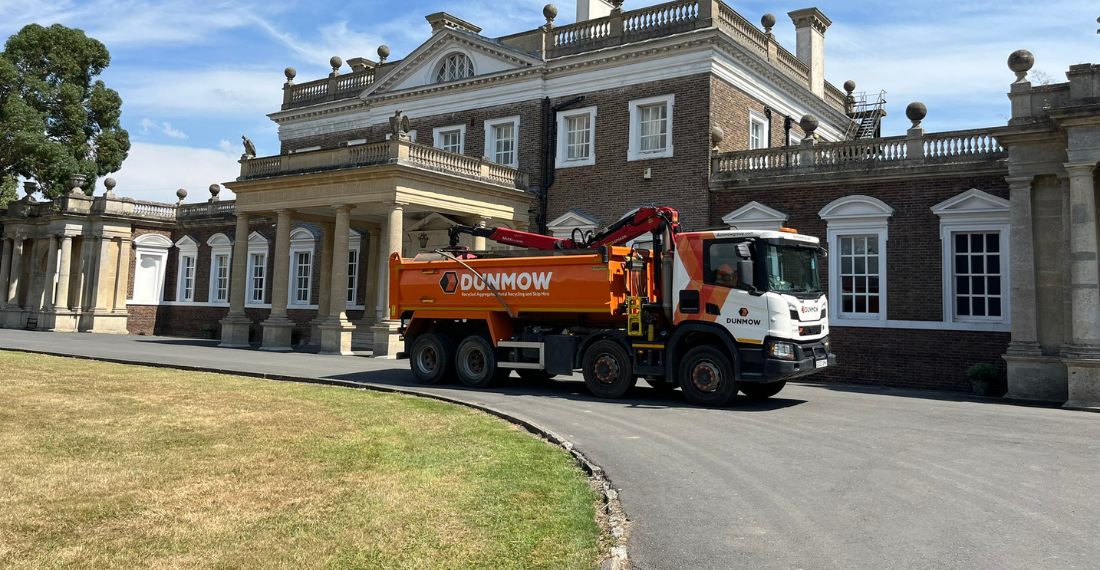
Once the load is read, the grab lifts it and brings it back to a recovery site or transfer point. Where the job allows, we keep different materials separate in the lorry’s body rather than mixing everything into one heap. A separated load is worth more and far easier to recover than a mixed one, so a little care at the loading stage pays off all the way down the chain.
At the recovery site, the load takes one of two main routes, depending on its type.
If the material is heavy in sand and stone, it goes to a wash plant. If it is mostly soil with a few roots and bits through it, it goes to a screener. Both are recovery routes, and both turn your dig into a saleable product. Only a small residue and material that genuinely cannot be recovered end up at a restoration site or, as a last resort, in landfill. The details of which loads need a soil report before they can move, and why a wash-plant route differs from a muck-fill route, are a subject in their own right that we cover separately.
A wash plant does exactly what the name suggests. The material is washed with water and separated by size and density. Screens grade it, the washing action scrubs soil from the stone, and the fractions emerge clean and sorted. Sand, stone, and aggregate are recovered, with the useful fraction, typically from around 40 mm up to 80 mm, graded into a recycled aggregate product. The fine silt and clay settle out and are managed separately.
What goes in as dirty, mixed dig comes out as clean, graded, saleable sand, stone, and aggregate. That is the heart of the recycling story: the wash plant is where yesterday's muck becomes tomorrow's building material.
Soil that does not need washing goes to a screener instead. The material is passed over mesh decks that separate it by size, removing roots, oversize stone, and debris. What is left is clean, screened soil, a resellable topsoil or fill product, while the roots and oversize are handled in a separate stream.
Screening is the lower-energy cousin of washing, and for a load of decent soil, it is often all that is needed to turn a dig into a saleable product.
There is one part of washing that people forget: the fine silt and clay scrubbed off the stone have to go somewhere too. They settle out in tanks or lagoons, are dewatered, and the resulting fines are not simply thrown away. Depending on their quality, they can be used as fill, in land restoration, or for capping, the same engineered role that clay plays elsewhere, as discussed in our dedicated piece on clay as engineered fill. So even the leftovers of the wash plant usually have a job to do. It is one more reason the recoverable fraction of a clean load is so high and the fraction sent to landfill so low.
The recovered sand, stone, aggregate, and screened soil do not sit in a yard. They are sold back out to other customers, often straight back into construction and landscaping. The material that arrived as your muck-away becomes someone else's TYPE 1 sub-base, sharp sand, or topsoil. The loop closes, which is the whole point.
Only the genuine residue, the small fraction that cannot be recovered, goes to a restoration site or a landfill. In a well-run operation, that fraction is small, which is exactly how it should be.
Here is the whole journey in order.
Three things follow from all of this, and all three are to your advantage.
Our five values, Passion, Innovation, Trust, Community, and Hard Work, are how we run the grab operation, not just a poster on the wall.
Choosing Dunmow Group means choosing a safe, compliant partner that delivers value for money and keeps muck away, fast and easy, recovering as much as the material allows and sending as little as possible to landfill. We do what we say, and we can prove where it went.
Your muck-away is not the end of the road for the material. For most of it, it is the start of a second life. Read it right, keep it clean, and the great majority is washed, screened, and sold back into use, with only the genuine residue going to disposal. That is cheaper for you, better for your reporting, and better for the county. Tell us what you are digging, and we will take it on its proper journey. Talk to us.
Chelmsford: 01245 466646 | Clacton: 01255 360031 | Colchester: 01206 307070 | dunmowgroup.com | WhatsApp: 07902 802802

Dunmow House
Regiment Business Park
Eagle Way
Chelmsford, Essex, CM3 3FY
Call us: 01245 466646
Gorse Lane Industrial Estate
Stephenson Road
Clacton-On-Sea
CO15 4XA
Call us: 01255 360031
Dunmow House
Regiment Business Park
Eagle Way
Chelmsford, CM3 3FY
Call us: 01245 466646
Gorse Lane Industrial Estate
Stephenson Road
Clacton-On-Sea
CO15 4XA
Call us: 01255 360031
Morses Lane
Brightlingsea
Colchester
CO7 0SD
Call us: 01206 307070
Copyright © 2025 Dunmow Skips Ltd T/A Dunmow Group. All Rights Reserved.


No Comments Yet
Let us know what you think